
Story
The war is about to end. The dust settles on the battlefield as half of the Nobles of the realm are caught inside of the Royal castle on the losing side of the war. The negotiations, the tears, and the drama are bound to follow while everybody struggles – some for justice, some for revenge, and all for their future.
The Ladies and Lords of The Starlands face each other following a war that has ravaged their lands for a year and left the principalities’ economies, lands, and relationships in tatters. Family bonds, old friendships, and plans of strategic weddings lie shredded, while long-standing rivalries, brutal war crimes, and mutual hate has split the realm into two opposing factions.
But maybe there is also love, hope, and future out there for those who seek it…

Style of the setting
The Starlands is a bespoke setting where only humans exist – no monsters or other races. It is medieval/renaissance/low fantasy in aesthetics and regarding technology level, there are no guns and horses are the preferred means of transportation if you can afford it. Besides that, you travel by foot. There are no doctors, but there are ‘healers’. They know of the use of herbs, amputations, leeches and mercury, but nothing more advanced than that.
Spoils of War has a feminist setting design, meaning that you can have many different kinds of larp experiences and character types no matter the gender you would like to portray.
There is no explicit magic in this setting. There is, however, plenty of superstition, and many people feel convinced that especially the forests contain mythical creatures and places.
The Starlands
The entire known world is The Starlands. There’s no other realm than The Starlands and the surrounding seas. The Starlands consists of two half-islands. Travelling from the southernmost part of Sevantier to the northernmost part of House Lynx’ principality, Darkfield, is approximately six weeks by horse.
The Starlands is divided into nine principalities, each with its own Lady or Lord as their Head of House. They have always paid tribute to the Monarch, who for most of history were mainly Queens, but for the past 20 years has been a King.
The four western principalities are collectively called ‘The Coalition’ since they joined in rebellion, while the four principalities east of them are known as ‘The Loyalists’.
‘Darkfield’, the principality furthest to the east, has remained unengaged for most of the war, but recently joined the fray, declaring officially for the Loyalists – but their army and most of the House joining The Coalition. This has tipped the scale in the favour of The Coalition so the war is coming to an end.
World map
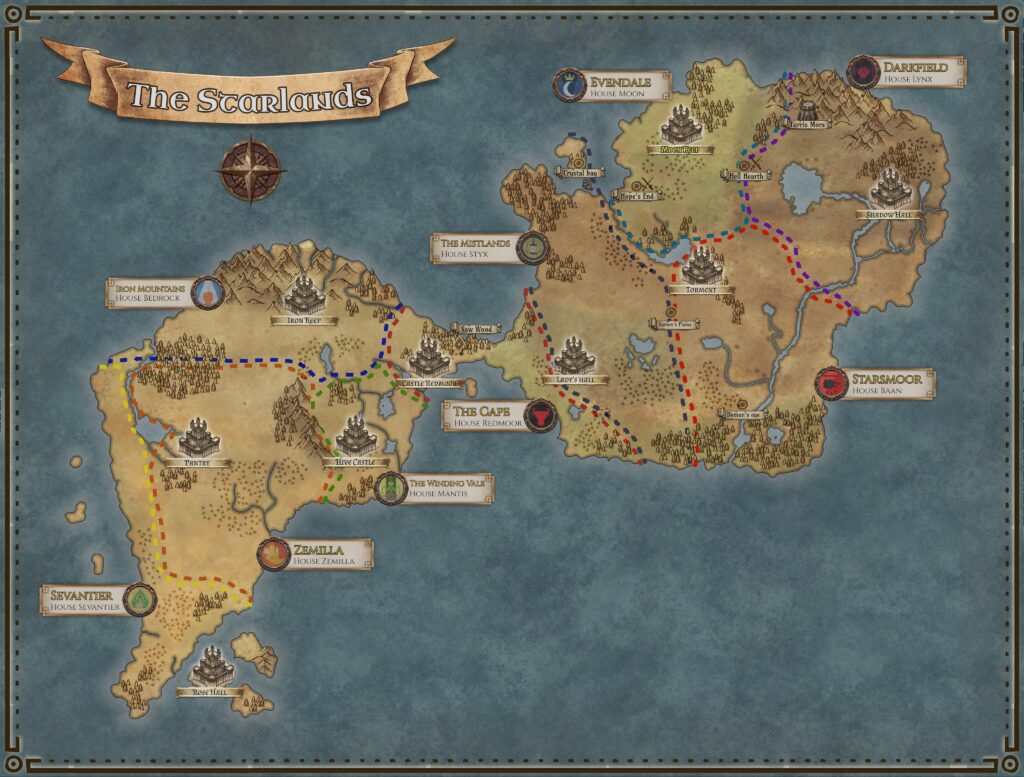
Situation at the beginning of the larp
The King and his Loyalists have lost the war and are garrisoned in Moon Keep, the ancient Royal castle of The Starlands. The Keep used to belong to House Moon before their murder and usurpation at the hands of the Houses Redmoor, Styx, Baan, and Hala, as well as their Woodlander allies, 17 years ago. Now, these very Houses, as well as Lord Lynx, await their impending doom or salvation within the Castle halls. In the siege camp outside sit the forces of The Coalition, composed of the Noble Houses Bedrock, Sevantier, Zemilla, Mantis, and all the forces of House Lynx. These Houses have risen in rebellion under a common banner to instate Princess Natascha Moon, the only survivor of House Moon as the future Queen.
The two sides are divided at the beginning of the larp, but on the second day of play, the winning side WILL succeed in taking the castle.
Important setting elements
Monarchy
The Starlands has been ruled by a Queen from House Moon of Evendale as long as anyone can remember. Only when there was no female heir has The Starlands been ruled by a King. The regent has a mystical status, and everyone in The Starlands agrees that there should always be a monarch.
The monarch is a unifying figure who demands respect, and who will interfere in case of strife between principalities and attacks from Woodlanders. However, it is important to note that the regent doesn’t interfere in all small details in the principalities. They all have rulers who are Lords and Ladies in their own right, and the regent’s status is mostly ceremonial. It is, however, taken deadly seriously by the citizens in The Starlands.
Salutation
Commoners and Woodlanders are usually referred to by their first name. They are not bound by the duties of a family name, which means more in noble families where succession is important. ‘My Lady’ or ‘My Lord’ is always appropriate and polite, if you don’t remember a noble character’s name or exact status.
The spouse who has married into a noble house keeps their old house name as middle name. This is how you can see, who was the heir to the regency of the house, and who is the spouse, e.g. Lord Kirill Mantis Styx is born in House Mantis and is now the husband of Lady Styx. A few spouses won’t have a middle name. This means that they are born commoners or woodlanders, which is mostly frowned upon. Military Generals and Commanders will be titualted this in front of their other titles.
Fertility
Fertility in this setting is very limited, and varies a lot from person to person. A married couple will on average have two to three children during a lifetime, while many – both men and women – experience not being able to reproduce at all. Some select few are, meanwhile, apparently able to have as many children as they want. These people are seen as blessed by Life itself.
As a result of the low fertility, the world is sparsely populated. The population of all of The Starlands consists of about a million people. It’s unlikely for a principality to have armies of more than 8.000 capable soldiers. The low number of citizens and soldiers is another reason that Life itself is perceived as holy. Every single life matters, as you can read in the description of the religion below.
Trials
In every principality, the Lady or Lord determines guilt and sentence in all criminal cases along with a number of jurors. In cases where the Lord or Lady cannot be personally present, they appoint substitutes who wield their power for them and speak with their voice and authority. A common duty for all religious figures, most often Quasitors, is assisting with trials. The formal rule is that at least one religious councilor, and preferably more, must always be part of the trial to sit as assessors and help pass sentences. They will also be crucial in what possible punishments will be necessary in the aftermath of the war.
In conflicts between citizens from two different principalities, the religious figures are often used as councilors and negotiators in strife between two Ladies or Lords if there is doubt about guilt. In the case that a Lord or Lady clearly maintains the claim that someone is guilty of a crime, but the accused obviously hasn’t done anything, the Quasitors will sometimes push for reducing the penalty to a symbolic one.
The penalties can be everything from community service and smaller fines to imprisonment, becoming wards of another House, hard manual labour, dismemberment, stripping of lands and titles or in the worst cases; death. An assessor Council without a Mortan can never pass a death penalty. Both political and religious figures in Councils can make cases for a death sentence but it can never be passed in a case without a Mortan on the Council.
Despite this, many people still consider it a breach of The Absolute Holiness of Life to proclaim a death sentence. But there are more mixed opinions on this since The Great Sin.
Negotiations
In The Starlands, there is a tradition that negotiations are held publicly, right in the middle of open halls. They are not democratic, but everybody can listen in. This is where grand gestures as friends or foes can be made, bargains can be declared, and tough decisions are harshly made according to whomever has the greater political, personal or military might.
Each House has a seat at the table and can speak on their House Head’s behalf, and someone else from the House may take the seat instead of the one who started the negotiation at any time.
Life in The Starlands
People in The Starlands can reach up to 200 years of age, but an especially healthy and privileged lifestyle can add several decades to this. In spite of this, it’s only very few who experience this kind of vitality, since most people live hard lives and wear themselves out long before that.
A hard-working farmer will feel the effects of their life conditions and will be considered (and appear) old at 60, while a well-tended noble will be able to keep their youthful appearance until they are about 100 years old.
That doesn’t mean that you are not a grown-up until 40 years of age. Most girls can still get pregnant from the same point as people who can carry a child in our day and time, and marriages for noble children are normally arranged while they are 15-30 years old. It is, in any given case, unusual for a woman to have a child after the age of 80.
In effect, the number of adult years before the body starts showing signs of old age can be stretched out, especially for the nobles. You can have the physique of an 18-year old well into your 40ies but you can also have grey hair already in your early 20ies even as a noble. The amount of aging that a body sustains during these decades is reduced roughly by half, compared to the real world. Therefore, the Ladies and Lords of the different houses are of very different ages.
In many commoner communities, rumour has it that it is the noble blood itself that provides the nobility with its youth, and some suspect that their lieges might consume special herbs or mixtures to prolong their lives.
Religion
The religion of all principalities (apart from The Mistlands, where House Styx rules), is a religion of life – it is known as the Faith of Life. The expecting mother, father and Life itself are holy, and the murderer is cursed in the eyes of the faithful.
The greatest thing you can make of your life is providing room for life and giving new life. Fertility – concerning children, but also crops and animal breeding – is subject to great admiration. ‘The Absolute Holiness of Life’ is respected over everything else.
All principalities have slightly different interpretations of the faith and practice it in different ways. Woodlanders follow their own version of the Faith of Life, and while Mountain Folk pay tribute to Life, they also worship spirits. Both of these are controversial in their own way.

Quasitors
A priest of the Faith of Life is called a Quasitor. Quasitors are representatives of Life, so in order to become one, it is required that you have given a life (that is; had a child), regardless of whether within or outside the boundaries of marriage.
In order to become a Quasitor, you have to be ordained in person by another Quasitor. You then step out of your former family and renounce your family name. From this point on, you are no longer (officially) interested in matters concerning your former family. The decision can never be reversed and you serve in this capacity the rest of your life.
No one has authority over Quasitors but they will usually act and serve as spiritual guides in matters of Life and hold ceremonies. Quasitors can have many functions, but often they will continue their old endeavors – such as farmers, midwives or stewards. Some choose to abandon their principality to live and serve in a temple or with a family who can’t conceive children on their own.
Quasitors don’t undergo any formal education in order to be appointed to their position. Instead, they are usually nominated because of a certain quality. They could be very wise, decisive, or have a strong sense of judgement or empathy. They could also simply be especially blessed with great fertility or success with their crops, and be viewed as chosen by life itself. Thus, they are not necessarily educated or learned people.
Nobles have to find a whole new life for themselves upon becoming a Quasitor, since they will have been used to being ‘someone’ simply because of their name. Now they need another purpose. So often, nobles only become Quasitors if they are especially pious and wish to answer a call, or if they want a good excuse not to be married to someone they hate.
This equality is the formal ideal – in principle. In practice, however; the noble bearing, long life and powerful friends of a noble Quasitor will more often than not have a strong impact on their success and influence in their new office.
Mortans
The counterpart to the Quasitors come in the form of Mortans – Priests of death. Mortans handle funerals and inspect dead bodies as the first people after death has come. Mortans often tend to ominously show up a short time before or after a person dies – no matter the cause. This apparent premonition of death has given them a dire reputation.
To be a Mortan is a rare but very necessary position that doesn’t contain much glory, honour or admiration. Mortans are viewed as cursed – often treated as creatures more than people. They can talk with and be around others, but their view on Life always has Death as a focus. However, a Mortan also grieves with the relatives and cry for their loss, being a steady presence in a time of distress.
The Mortans are all trained in Turris Mors, a tall tower that reaches above even the highest mountains of Darkfields, House Lynx’ principality. It’s said that the Mortans are gathering to be taught dark secrets and powers. There are many rumours about what these powers are. In spite of this, the only certainty is that Mortans seem almost untouched by time. Many farmers will insist that they have seen the same Mortan send grandparents, parents and siblings from this world after their death.
It is considered a very ill omen to have a Mortan in your vicinity. Therefore, they are often chased away by villagers where life is good. But they always come back to attend the deceased. A Mortan is not always in the near vicinity of a deceased person, and then the family will have to put their loved one to rest themselves, which often scars them for life.
Mistress of the Mist
People in The Mistlands, with House Styx as regent Ladies, have their own religion in which Life isn’t as holy as is a given in the rest of the world. Most people will only have heard rumors of strange heresy, but in learned circles, some details have been revealed over the years.
The religion is dualistic and revolves around the difference between The Clean Water and The Abominable Water but includes the worship of a deity called The Mistress of the Mist.

Woodlanders
The Woodlanders are humans that many centuries ago chose to leave the known civilization to live in the forests. Woodlanders and City Folk can speak with each other, but their cultures have grown more and more apart.
The Woodlanders practice a religion very similar to the City Folk, where the one most important philosophy is The Absolute Holiness of Life. The Woodlanders’ obsession with Life comes with a very harsh view on Death. In this version, Death is viewed as something shameful, and something to be avoided at nearly all costs. Preserving life has the utmost priority in all aspects of their society. Those who are mortally wounded and ill are not abandoned before their life has decisively left their body.
Dead people are not shown any respect, and an early death e.g. by illness or accident is perceived as a great shame and unholiness. You can mourn a lost life, but if a person died, the living are immediately a priority. A dead body is preferably dismembered so that it can be put in the ground to fertilize it – if the meat is young and fresh, cannibalism isn’t unheard of; neither is feeding the deceased to dogs or wolves. Because of this fierce hatred of Death, Woodlanders find the unholy existence and acceptance of Mortans the greatest heresy of the City Folk.
Woodlanders in general perceive City Folk as tied up by their rules, lands and families. As Woodlanders, you connect as mates more than as spouses, and the worship of Life is more focused on the collective than individuals – everybody in your Grove is your next of kin, and is just as willing to help you as your mother or blood brother. You choose to join your family and choose to leave it just as willingly. Many Woodlanders wander through several Groves before they find a mate who fits them, and even then it’s not necessarily for life.
Some Woodlanders have married into City Folk families and in some principalities, the two cultures are almost assimilated. The most extreme version is in The Cape where the children of House Redmoor spend a year in the grove of Saw Wood to connect with their people and they live intertwined lives.
There is a long history of racism on both sides. Most Woodlanders perceive City Folk as too negligent in their worship of Life, and not as civilized, as especially the nobles cling on to their blood families and allow that to decide their fates. Woodlanders are often used as cautionary tales for children in the cities, but especially for the last 100 years, the Woodlanders have been mostly withdrawn to the deep forests. Woodlanders refer demeaningly to Starlanders as ‘Wall Dwellers’, and in return, ‘Bush Rockers’ is a common derogatory term.
The Great Sin
The Great Sin happened 150 years ago. During this time, Woodlanders and City Folk lived mostly in peace. But some Woodlanders had grown more extreme and full of righteous hatred over the developments for City Folk, who had taken more and more of the forests for themselves. Leaders of different Groves gathered and agreed to strike at the different principalities. A huge number of cities and villages were wrecked, townspeople were brutally massacred and only the largest cities and stone castles and houses survived. Survivors were taken as working slaves for the groves. The killing of City Folk was contradictory to the Absolute Holiness of Life, as some pointed out, but a precedent was set that “rooting out weeds that were strangling all other vegetation” was necessary. And so the willingness to utilize violent means became normalised in many Woodlander groves.
But the Woodlanders were not alone. They had joined forces with Lord Ranos Redmoor. In The Cape, there was almost complete assimilation between Woodlanders and City Folk. The understanding between them was great, and next to no racism existed. Even Lord Ranos himself had Woodlander blood in his veins and was married to one. Ranos saw an opportunity to make his neighbors weaker and thereby strengthen his own position. Some say that Lord Ranos Redmoor and his kin helped ignite the strife further in many other principalities to be able to invade and expand his power at a later date. However, none of this was ever proven.
In the end, Lord Ranos Redmoor just had a stronger power base in his own principality, and he earned fortunes owning the only land passage between the West and the East. He later became known as ‘Ranos the Traitor’ among his detractors.
After this war, the parties separated and vegetation started to grow wildly over many villages, making more room for Woodlanders everywhere. Some City Folk turned to mysticism to find meaning in the madness and comfort in the terrible situation.
City Folk slowly rebuilt their societies and moved together in bigger cities. The Woodlanders didn’t have the weapons or patience to assault castles or larger cities, so they also drew back. In most areas, there has been bitter animosity between the two cultures ever since. City Folk and Woodlanders have, in the best cases, lived unwillingly side by side, and in the worst cases actively tried to exterminate each other.
More recently, a new time calculation has been put into use. That is ‘After the Great Sin’, or A.S. for short.
The Mountain Clans of Iron Mountains
Rural areas of the House Bedrock’s principality are inhabited by clans folk increasingly untouched by civilization. People of the Mountain Clans value ‘The Steel Blood’ of the mountain people above all, believing themselves to be more fit and able than others. House Bedrock are balancing their rule to keep both lowlanders and Mountain Clan people in line and they usually succeed.
While some lowlanders might consider the Clanfolk and the Woodlanders to be quite alike, the mountain-dwellers have fought Woodlanders before and would take great offence to any comparison.
Yet, there is one place where the Clans of the Mountains can agree with the Woodlanders. Spirits.
The Iron Mountains are filled with plenty of spirits that inhabit the world around them. The ancient peaks have names, and people isolate themselves for days on certain mountains to seek knowledge.
But fiercest and wisest of all are the Winds. There are four Wind-speakers at all times – women of special, spiritual calling.
The Mountain Clans are strictly divided in their gender roles in general. While only women can be Wind-speakers, only men can be soldiers and rulers. Because of this adamant belief, even the Mountain Clans begrudgingly accepted their current lowlander Lord as ruler when he married the only child of Bedrock, the woman Lorraine. So even though they respect his Bedrock wife much more, it is unthinkable for House Bedrock or the Mountain Clans that they could be ruled by a woman.
The usurpation 20 years ago
20 years ago, a new Redmoor stirred in The Cape. Victor Redmoor was the grandson of Ranos, and at least as ambitious. Everything changed when he usurped the throne of House Moon.
Lord Redmoor made a deal with Lord Richard Hala, who was the steward of House Moon’s lands, Evendale. Lord Hala, like many others, was sick of Queen Mathilda Moon’s racism and oppression both towards the Woodlanders and toward his good friends in House Styx and their religious practices. Lord Hala was a political mastermind and a steady hand in the rule of Queen Mathilda Moon – and after careful consideration he assessed that Lord Redmoor would do much better as a king than the paranoid queen. And put the demand forward that Victor Redmoor would marry his daughter, Vicana Hala, so she would be queen. Until then, she had been engaged to the young prince James of House Moon.
There was an issue with this marriage proposal. Victor Redmoor was already married to Lady Sira Zemilla Redmoor. But after four years of no children, Lord Redmoor had the marriage declared cursed and annulled by Quasitors in The Cape and his formidable advisor Mortan Xia. Lady Sira was sent back to House Zemilla, which was a great slight towards both her and her family. Just a week later, Victor Redmoor married Vicana Hala instead and made her queen. It was no more than a month before she was pregnant with twins. Woodlanders thrived and many houses prospered but with others, discontent over the brutal new King arose and is now culminating in a world war.
Characters and their families
Here is a link to the description of the family trees, lineages and alignments. It contains light spoilers if you enjoy looking for that, and there are descriptions of the meaning of each element in the document:
House banners

House descriptions
The side of King Redmoor
The side of Princess Moon
House Redmoor

Name of principality: The Cape (the last 20 years rulers of The Queenland)
Succession: Oldest child
Name of stronghold: Castle Redmoor (and Moon Keep after Victor became King)
It is said… A Redmoor is agreeable, charismatic, sophisticated, and highly efficient. They are great tradespeople and negotiators, able to close any deal. Their many years of cohabitation with Woodlanders have made their lands and family prosperous and diverse. Many of them are excellent fighters and duellists. Their immense pride in their legacy is well founded.
However, it is said… The Redmoors are treasonous, warmongering, usurping glory hounds who are openly fraternizing with and influenced by Woodlanders, proving their deprivation. They are calculating coin counters who trick you into lousy deals. They are inconsistent and vague and hold no firm principles. They put far too much pride in their dishonourable legacy.
House strengths: Woodlander support. Domain of The Starland’s greatest trade city.
House weaknesses: Dependency on Woodlander support. Geographically surrounded.
Due to its advantageous placement as the main passage from The Western Principalities to The East, The Cape has always been an immensely lucrative domain. House Redmoor are infamous warmongers, and prominent actors in some capacity in most of the greater known armed conflicts of history, whether or not they had a hand in starting them. The Redmoors are very protective of their traditions, people, and interests. War has made them infamous, but trade has made them rich. Rich enough, some would say, for more war. War that has then spurred on more need for trade.
They are the most lenient Noble House regarding Woodlanders. The two cultures live side by side in The Cape, and their different ways are honoured – though their homes are kept largely separate. King Redmoor openly keeps a woodlander as one of his closest councillors.
The future of House Redmoor is uncertain.
House Moon

Name of principality: Evendale (Formerly;ousted by Victor Redmoor)
Succession: Oldest daughter
Name of stronghold: Moon Keep (Formerly; until usurped)
House Moon is the ancient House that has ruled The Starlands for as long as anyone remembers. They have an almost mystical status with special connections to the Moon and Life itself. Before the War of Independence, the house even ruled all The Starlands as a mostly symbolic but extremely important royal family.
But 20 years ago, Queen Mathilda was ousted from power by a hasty war with Victor Redmoor, who became king.
The great house got all but extinguished, but the baby daughter Natascha that no one knew anything about had been sent to House Sevantier together with a toddler from House Hala. Young Natascha is now being pushed back towards the throne by conspiring Houses in The Coalition. But who can Princess Natascha actually trust?
It is said… House Moon was an almost mythical presence in The Starlands and they were part of a belief system that there is meant to be a monarchy. They ruled in a way that didn’t overstep the independence of each of the principalities and they helped mediate in strife after strife between the Lords and Ladies of The Starlands.
However, it is said… They are paranoid, racist towards Woodlanders, vengeful on dissenters, and would not allow any religious freedoms especially for House Styx. The arrogance and paranoia was their downfall in the eyes of their detractors.
House Styx

Name of principality: The Mistlands
Succession: Oldest daughter
Name of castle: Lady’s Hall
It is said… A Styx is intimidating, mysterious, and fearless. They see many things that others do not, and their heathen worship and use of magical concoctions grant them unnatural abilities beyond those of regular mortals.
However, it is said… They are soulless heretics and misandrists. Their polygamous traditions are an abomination in the face of Life. Their use of mind-altering substances drives their wicked ways and poisons their minds, rendering them insane and making them see ghosts.
House strengths: Since nobody understands their realm like they do, House Styx holds a monopoly on trade routes going through the Mistlands and possesses great monetary wealth due to trade fees and taxes. They command extremely high loyalty amongst the locals due to being protectors and practitioners of the local religion.
House weaknesses: Their lands are infertile and untraversable with few natural resources. Due to religious customs involving powerful mind-altering substances, the Styx lands have long had issues with drug abuse. This has spread rampantly outside their borders since King Victor deregulated trade, however, and without proper guidance, drug users experience severe consequences.
Description: House Styx has always had a mystique to it. Most of the inhabitants follow the ancient religion of The Mistress of the Mist, and it is said that they hear whispers from their dark Goddess and have means to speak to her in their prayers.
The Mistlands are always shrouded in a thick, impenetrable fog, especially in the swamp areas. The more trThe House earns a lot of its money from renting out ‘Lantern Bearers’; elite soldiers and experts on navigating the dangerous and impassable swamps. Without a doubt, the bloodiest skirmishes of the war have been fought in the Mistlands. Thousands of soldiers have died in the swamps while trying to pass through the fog, and even more have been traumatised by the constant fear and paranoia of marching for days without being able to see more than a few feet ahead.
House Styx is fiercely matriarchal and is rumored to be direct descendants in the female line from the younger daughter of the first Queen Moon. It is customary that the females of the house marry more than one man.
House Sevantier

Name of principality: Sevantier
Succession: Oldest child
Name of stronghold: Rose Hall
It is said… A Sevantier is charming, beautiful, and sensual. They are famously skilled philosophers, artists and artisans and produce exquisite works and crafts. They are skilled sailors.
However, it is said… They are promiscuous, pampered, untrustworthy hedonists. They eat, drink, and talk too much, and they work too little. All their privilege stems from lucky geography, hogging wealth, and artificially inflated prices.
House strengths: Great social mobility and high quality of life. They have the greatest navy in all the Starlands. Trade currents only go northeast, allowing Sevantier the fastest and easiest sea travel to anywhere.
House weaknesses: A very low birthrate which many attribute to Life shunning their overly promiscuous ways. Overreliance on slavery in the work force, especially as galley rowers.
House Sevantier are the southerners of The Starlands. They are inventors, scholars and strategists. Whether the art is jousting, wine production or painting doesn’t matter – They will create. This makes them attractive conversation partners and lovers. Not to mention that inventions from the great minds of House Sevantier have greatly improved weapons, hugely impacting the war. They have secretly been the foster House of Princess Nathascha Moon for 20 years, since her family was killed when Victor Redmoor became King of The Starlands. They have presented her as an alternative to King Redmoor.
The current Lord and Lady are flamboyant and good company, but the real schemers of the house work behind their colourful presences trying to put Princess Moon on the throne – not only because it’s morally right, but because it’s valuable to have fostered the future regent of The Starlands.
House Hala

Name of principality: Evendale (vassals to the regent house in Evendale)
Succession: Oldest child
Name of stronghold: Crystal Keep (and stewards of Moon Keep for the royal family)
It is said… A Hala is honourable, diplomatic, virtuous, scholarly, pleasant, patient, and pragmatic. They are survivors in the face of hardship and value a disgraced life over a glorious death. The House is ancient, tracing its roots back to the first Moon Queens.
However, it is said… They are disloyal, arrogant, slippery, sentimental, prudish, cowardly, naïve, and prone to inaction. A Hala is ever a servant, and whoever in a room is the bigger threat, they will bow down to. unquestioningly.
House strengths: High approval and living standards in their principality. They generally avoid the consequences of their (lack of) actions. Patrons of the greatest library and the most respected scholars in all of the Starlands.
House weaknesses: Their status as a vassal House, as well as their leniency towards lesser nobles, the Faith, and common people have left them with low tax incomes and troop recruitment.
Hailing from the beautiful shores of Crystal Bay, named so for its pristine, clear waters, House Hala claim to have been the first Nobles to swear fealty to House Moon, and their long and storied written tradition has produced numerous texts as proof. For generations since, they have been but stewards of Evendale, but they have been essential to any reigning Monarch.
20 years ago, Lord Richard Hala broke with generations of servitude to House Moon and opened the gates of Moon Keep to Victor Redmoor. His supporters assert that he had grown wary of Queen Moon’s escalating racism towards Woodlanders, and fully believed that Lord Victor would make a superior King. More critical voices whisper that he had been spurned by her and was willing to stab her in the back to fulfill a lifelong ambition of seeing a Hala – his precious daughter, no less – share the throne.
House Zemilla

Name of principality: Zemilla
Succession: Chosen among the sons of the Lord. The chosen heir lies with five chosen women, and those who fall pregnant and produce a living child become his wives. When the children reach adulthood, one of them is chosen as the new heir, while their father is the new Lord, and the former Lord abdicates. The mother of the new heir becomes the new Lady of the House, and the other mothers to the heir’s half-siblings become her Second Ladies.
Name of stronghold: Pantry
It is said… A Zemilla is productive, disciplined, thrifty, and above all: Fertile. They are known to be eager and hot-headed, willing to question and challenge authorities if they seem weakened. When dominance is asserted, however, they are perfectly willing to accept, obey, and apologize.
However, it is said… They are self-important, misogynist, and loud-mouthed. Their customs are strange and outlandish, and their treatment of the secondary wives is often regarded as dishonour upon the noble ladies.
House strengths: Highest population and greatest crop yield of the Starlands.
House weaknesses: The high number of potential heirs and circumstantial inheritance has led to some brutal infighting throughout the generations. General poor quality of their otherwise plentiful exports. Lowly skilled workers. They are incredibly delusional about their own products, however, and find them excellent.
House Zemilla is – first and foremost – fertile. They live in the Pantry of The Starlands, producing grain and greens. But they are also blessed with many children, which often creates squabbles and competition. They have an advanced tradition for succession that most other Houses scoff at. But marrying your child into this house will give the child a lifetime of wealth and plenty. So often, Ladies and Lords will risk a younger daughter’s future for a possibility to become the future Lady Zemilla.
Lady Sira Zemilla used to be married to Victor Redmoor. But after four years of no children, Lord Redmoor had the marriage annulled by a Quasitor council from The Cape, orchestrated by his close advisor, the Mortan Xia. Lady Sira was sent back to House Zemilla, which was a great spite on both her and her family. Merely a week later, Victor Redmoor married Vicana Hala instead.
House Baan

Name of principality: Starsmoor
Succession: Oldest son
Name of stronghold: Torment
It is said… A Baan is dangerous, strong-willed, effective, and ruthless. They are also known as great party hosts with some of the best, most diverse entertainment in the Starlands.
However, it is said… They are cruel, treacherous, murderous, and ruthless. House Baan have no morals and barely any feelings, and there are no depths they won’t sink to. One should always watch one’s back around them.
House strengths: The sudden, mysterious, and convenient disappearances of dissenters in their lands, as well as their associates and families. Many years as the main bulwark against the ever-present threat of Woodlander attack from the Blackwood have left Baan troops hardened, ready, and alert, and their armies are well-deservedly infamous for their prowess in battle.
House weaknesses: Their poor reputation precedes them. Much of their attention and resources are spent constantly keeping the Blackwood threat in check.
House Baan rose to power in Starsmoor when they supported Victor Redmoor in his usurping of the throne of The Queenland 20 years ago. House Baan was the greatest vassal house to House Oakleaf in Starsmoor and was generously rewarded. The invaders made sure that House Oakleaf was thrown from power, so House Baan could take over. House Baan is still fiercely loyal to their allies in House Redmoor.
As a house, the Baans have always paced their children relentlessly making sure to push all innocence out of them from an early age. They need to know how the world works: The strongest survive. Baan is a battle-ready house that holds fighting and ambition in high regard. Their knights – male and female – are second to none.
House Mantis

Name of principality: The Winding Vale
Succession: Oldest daughter
Name of stronghold: Hive Castle
It is said… A Mantis is pragmatic, polite, well-dressed, and dangerous.
However, it is said… They are misandrist, murderous, and careless. The House is upjumped low nobility, having reigned as Ladies Paramount for barely 2 generations.
House strengths: Incredible military results, local order and social mobility
House weaknesses: Any male orphan is forcefully adopted into the Mantis army, regardless of other family.
House Mantis are the spiders of the Coalition. They are always scheming – and also providing silk and cotton to all parts of The Starlands.
They have risen to power in The Winding Vale by making themselves more and more useful. House Mantis have only been regents in that principality for two generations, after House Weaver for some reason died out as a house in the female line. Nobody knows, if they had anything to do with the demise of Houses in The Winding Vale, but many have suspicions.
Mantis understands how to weave the family tightly together, but they are challenged by the strange illness their Lady is facing and more or less unruly children. House Mantis has pushed harder than most for putting Princess Nathasha Moon on the throne.
House Bedrock

Name of principality: Iron Mountains
Succession: Oldest son
Name of stronghold: Iron Keep
It is said… A Bedrock is resilient, strong, self-sufficient, and goal oriented. They are tough people from a tough environment, used to freezing, starving, and living off the land. They don’t complain but make their own fortune. They are incredibly ferocious fighters and independent thinkers.
However, it is said… They are uncultured, simple, and rude. Their strict gender roles, reverence of violence and bloodshed, and worship of mountain spirits are seen by many as religiously questionable at best.
House strengths: No one understands the Mountain Folk customs and are able to handle each clan as well as the nobles of House Bedrock.
House weaknesses: Mountain Folk are non-feudal and not oathbound to their liege, causing severe issues with hierarchy and discipline.
ouse Bedrock is acknowledged for their fierce fighters, and their enemies rarely stand long against them. The secluded mountains and cold make them a hard people and quite wild. They are often the centre of the feast when great houses gather, being loud and demanding attention. Their strong liquors are unbearable to consume for most. They have been lured into the war since they hate Victor Redmoor. Lord Bedrock is a former Oakleaf who was chased out of his lands, Starsmoor, when Victor Redmoor came to power.
Rural areas of the Iron Mountains are inhabited by clansfolk increasingly untouched by civilization. They value ‘The Steel Blood’ above all, believing the people of the mountains to be more fit and able than others. They don’t like their Queenland Lord.
Unaffiliated
House Lynx

Name of principality: Darkfield
Succession: Oldest son
Name of stronghold: Shadow Hall
It is said… A Lynx is willful, disciplined, loyal, and convincing. They are good at following orders to the letter, and their hierarchy is strictly enforced.
However, it is said… They are inflexible, isolationist, misogynistic, and regressive. They are also mocked as death-worshippers for their patronage of the Mortans of Turris Mors, with whom they are closely affiliated, and their open embrace of Death as a natural part of Life. They have historically engaged in and condoned suicide rituals.
House strengths: Generally low discontent among their people due to strong diligence and willingness to suffer their lot.
House weaknesses: Their largely barren lands.
House Lynx is an isolationistic house and has been minding their own business for centuries on end. It is in the mountains of Darkfield that Turris Mors – the tower of the Mortans – reaches up as a shadow over the land.
House Lynx rarely gathers with other great houses, and they kept out of the war between Queen Mathilda Moon and Lord Victor Redmoor 20 years ago. Even in the current war, they were very late to react. Lord Lynx had finally given his full support to his King Victor Redmoor, but the younger brother Lord General Vitus gathered all the troops behind him and turned on his brother’s orders. So now Lord Lynx sits in Moon Keep supporting King Redmoor, while his family and people are on the other side, having officially sworn allegiance to House Moon. Many whisper the word ‘traitor’ in either direction, but there is no doubt that Lord General Vitus turning on King Victor Redmoor was instrumental in losing him the war.
House Oakleaf (extinguished)

Name of principality: Starsmoor (Former; ousted by House Baan)
Succession: Oldest child
Name of castle: Torment (Former; until usurped)
House Oakleaf was before the first war 20 years ago a proud house very close to the house of Moon. They served as stewards and counselors to House Moon, while always standing by the Queen. Therefore, the House Oakleaf also suffered greatly, when House Moon was overthrown by Victor Redmoor. Few members survived, when the rebellious vassal House Baan chose to stab House Oakleaf in the back to become the new lords of Starsmoor under the rule of King Victor Redmoor.